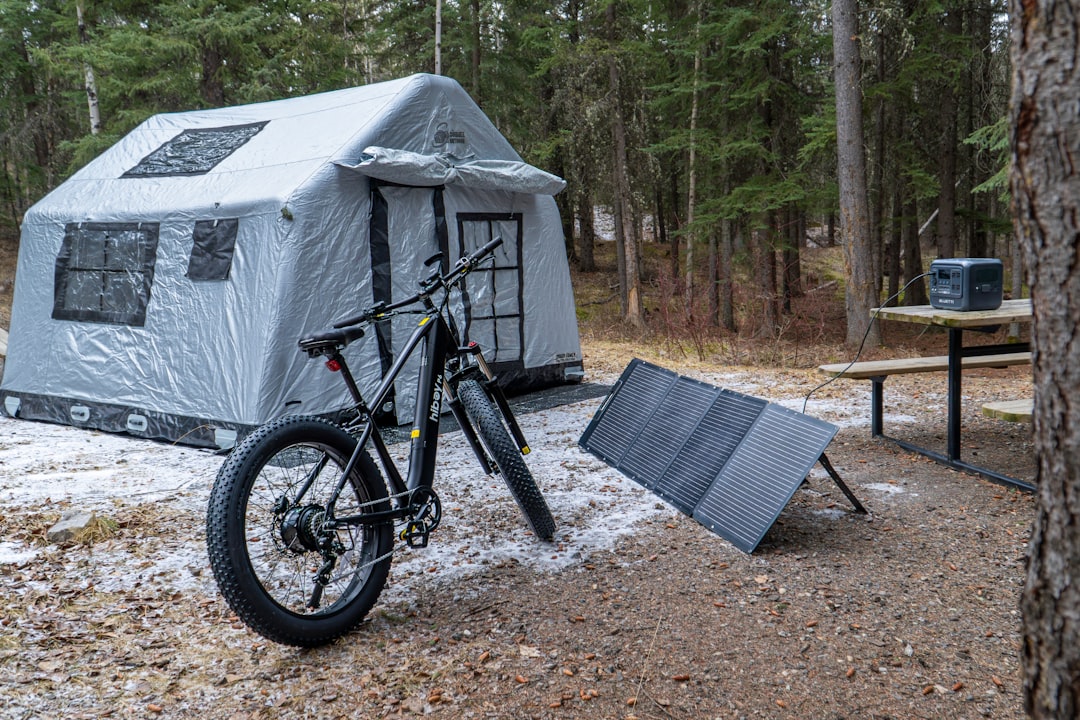
Sizing an off-grid cabin solar backup system for real critical loads is completely different from buying a camping power station.
This post contains affiliate links. If you buy through my links I may earn a small commission at no extra cost to you.
If you’re looking for a portable solar generator to keep the fridge running during a 24-hour outage, this isn’t that guide, start here for the mid-tier portable picks instead. This article is for cabin owners asking a different question: how do I back up my entire off-grid cabin, well pump, heat pump, chest freezer, the whole critical load, for days at a time without the grid?
I’m talking whole-home systems: 24kWh+ of storage, 240V split-phase output, enough continuous wattage to run a heat pump and a well pump at the same time. Over the past winter I tested four systems in this class at my Oregon cabin, logging real runtime under actual critical-load conditions. Here’s what survived the 18-inch snowstorm that took out my grid connection for 9 days.
Quick-Take Summary
If you just want the short answer before reading the full breakdown:
- Minimum capacity for a cabin with fridge + well pump + lights: 3,000Wh usable, with at least 3,000W continuous AC output and a 6,000W+ surge rating
- Battery chemistry that matters in cold PNW winters: LiFePO4 only, both NMC and LiFePO4 lose discharge capacity in the cold, but charging either chemistry below 32°F causes permanent damage, and LiFePO4 handles repeated cold-charge cycles better
- Expandability is not optional if you want multi-day autonomy without a propane backup
- Solar input matters as much as battery size, in western Oregon you’re working with 1.5 to 2.5 peak sun hours November through February
- My top pick for whole-home cabin backup: EcoFlow DELTA Pro 3 Solar Generator 4096Wh, a 3,000W+ LiFePO4 unit with expandable battery modules
Why Most Off-Grid cabin Solar Backup Systems Fail on Real Loads
The marketing on these units is written for RV campers, not people trying to keep a well pump and a refrigerator alive through a week-long outage. Here’s what I learned the hard way.
A standard residential refrigerator pulls around 150W average, but it surges to 400 to 600W on compressor startup. That’s manageable. The real killer is the well pump. My 1/2 HP submersible pump runs at about 750 to 900W continuously but demands a startup surge of 2,000 to 4,000W depending on static head and pipe length. The first time I tried to start the pump on a 2,000W-peak unit, the inverter shut down with an overload fault, a blinking red LED and a single error code I had to look up in a PDF manual I’d never downloaded. I had no water for 36 hours while I figured out what went wrong, eventually tracing it to the surge spec buried on page 14 of the inverter manual.
The minimum surge rating you need to run a 1/2 HP well pump alongside a fridge and a few LED circuits is approximately 6,000W peak. For a 1 HP pump, which is common on properties with a deeper well or longer pipe run, you need to be looking at 7,500 to 10,000W surge capability. Don’t let anyone sell you a 3,000W continuous unit without confirming that peak surge spec in writing.
The LiFePO4 Requirement for PNW Cabin Use
I ran an NMC power station through my first winter up here and watched it lose capacity by January, partly from cold discharge losses, but more critically from charging the unit in the unheated utility room below 32°F, which causes irreversible lithium plating in any lithium chemistry. Any lithium battery, NMC or LiFePO4, must not be charged below freezing. The difference is that LiFePO4 cells are more tolerant of the abuse and recover better, while NMC cells suffer permanent capacity loss faster under repeated cold-charge cycles.
NMC and LiFePO4 both lose discharge capacity below 32°F, but charging either chemistry below freezing causes permanent lithium plating damage, which is the real risk in an unheated utility room. LiFePO4 (lithium iron phosphate) can discharge safely down to about 14°F (-10°C) with reduced performance, and critically, it tolerates cold-charge cycles better than NMC, though neither chemistry should be charged below 32°F without a built-in battery management system that prevents charging until the cells warm up.
More importantly, LiFePO4 cells are rated for 3,000 to 6,000 charge cycles versus 500 to 1,000 for NMC. On a daily-use backup system that charges from solar every day, that cycle life difference translates to roughly 8 to 15 years of service versus 2 to 3 years.
If a unit doesn’t explicitly state LiFePO4 chemistry on its spec sheet, assume NMC and plan accordingly. BLUETTI AC200L Portable Power Station 2048Wh is a strong LiFePO4 option in the mid-capacity range (around 2,000Wh) that works well for smaller cabins where the well pump load is handled separately.
How to Size a Solar Generator for an Off-Grid Cabin in Oregon
This is the calculation I wish someone had walked me through before I bought my first unit. Here’s the actual process I use, based on our western Oregon property.
Step 1: List Your Critical Loads
| Appliance | Running Watts | Avg Daily Hours | Daily Wh |
|---|---|---|---|
| Full-size refrigerator | 150W avg | 24 (cycles approx. 30%) | 1,080Wh |
| Well pump (1/2 HP) | 800W | 1 hr total | 800Wh |
| LED lighting (6 fixtures) | 60W | 5 hrs | 300Wh |
| Heat blower control board | 200W | 4 hrs | 800Wh |
| Phone/laptop charging | 100W | 3 hrs | 300Wh |
| Total | 3,280Wh/day |
Step 2: Apply a PNW Winter Efficiency Factor
In western Oregon from November through February, I log 1.5 to 2.5 peak sun hours on clear days, use NREL’s PVWatts tool to check your specific location. Another useful too is NREL solar resources maps. On overcast days, which is most of them, I’m getting 0.5 to 1.5 effective hours. I plan my battery autonomy around 3 days of zero solar input, which means I need 3 × 3,280Wh = 9,840Wh of usable storage for a true 3-day buffer.
Step 3: Account for Depth of Discharge
LiFePO4 can safely discharge to 80 to 90% DoD. A unit rated at 10,000Wh gives you roughly 8,000 to 9,000Wh usable. To hit my 3-day buffer, I need either one large unit above 10,000Wh capacity or a modular system I can expand.
Step 4: Size Your Solar Input
To recharge 3,280Wh in a single day with 2 peak sun hours, a realistic Oregon winter target, I need a minimum of 1,640W of panel capacity (3,280 ÷ 2 = 1,640W). In practice I run 1,200 to 1,600W of panels to account for shading, angle losses, and dust, and I accept that full recharge in a single winter day is rarely achievable. Renogy 400W N-Type Monocrystalline Solar Panel covers a quality 400W monocrystalline panel option that I’ve used to build out arrays on metal roofs, two or three of those gets you into the right range.
Step 5: Verify Your Inverter’s Surge Rating
Before you buy, pull up the spec sheet and find the “peak surge” or “peak power” number, not the continuous output. For a 1/2 HP well pump, you need at least 4,500W surge. For a 1 HP pump, budget for 7,500W+. This single spec eliminates more than half the units on the market for cabin whole-home use.
Expandable Battery Systems: Why Modularity Changes Everything
After the nine-day outage, I went modular. The concept is simple: a base power station with a high-wattage inverter that accepts external battery modules via a proprietary or standard DC bus. You start with one module, say, 3,000 to 4,000Wh, and add modules as your budget allows.
The practical advantage in a cabin setting is that you don’t have to buy all the capacity upfront. I added a second battery module six months after my initial purchase, which doubled my autonomy without replacing any hardware. The base unit’s inverter, MPPT charge controller, and AC outlets stay the same. Only the battery footprint grows.
EcoFlow DELTA Pro Ultra 6144Wh Power Station is the expandable high-capacity system I currently run for our cabin’s primary loads. It handles the fridge, lighting, and heat blower continuously, and I manually sequence the well pump to avoid stacking that surge on top of compressor cycles. The system accepts up to three additional battery modules, bringing total capacity to roughly 24,000Wh, enough for 7+ days of our full critical load without any solar input.
For a smaller cabin or a secondary bug-out location, Jackery Explorer 2000 Plus Portable Power Station offers a more compact expandable option in the 2,000Wh base capacity range that can grow to around 6,000Wh with add-on modules.
Real-World Cloudy-Weather Performance: My November to February Logs
Here’s what nobody tells you in the product reviews: the solar input spec on the box assumes full sun. In the PNW, you need to mentally discount that number by 60 to 75% for November through January.
My 1,200W panel array, four 300W monocrystalline panels on a south-facing 30° pitch, averaged 280 to 420Wh of actual daily harvest during overcast November weeks. I started logging these numbers after the second week of November 2023, when I realized my mental model of “some sun is better than none” was masking how little the panels were actually contributing, I’d assumed 600 to 700Wh on partly cloudy days and was consistently off by half. On clear December days I’d see 900 to 1,100Wh. The math is sobering: on a typical PNW winter week, I’m replacing maybe 30 to 40% of my daily consumption through solar. The rest comes out of battery reserves.
This is why the 3-day autonomy buffer isn’t a luxury, it’s the minimum viable safety margin. A single clear day mid-week can partially recover the bank. Without that buffer, you’re running a propane generator every other day, which defeats most of the point.
The other lesson from my logs: MPPT charge controller quality matters enormously in low-light conditions. A quality MPPT controller starts harvesting usable current at panel voltages as low as 18 to 20V, which means it’s pulling power even under heavy cloud cover. Cheap PWM controllers often don’t start until panel voltage hits 22 to 24V, which means they sit idle on exactly the days you need them most.
What a Whole-Home Cabin Backup System Actually Costs in 2026
Let me give you honest numbers based on what I’ve paid and current market pricing:
| System Component | Capacity/Spec | Approx. 2026 Price |
|---|---|---|
| Base power station (3,000W+ LiFePO4) | 3,000 to 4,000Wh | $1,600 to $2,200 |
| Expansion battery module (1st add-on) | 2,000 to 3,000Wh | $800 to $1,400 |
| Monocrystalline solar panels (400W × 3) | 1,200W total | $600 to $900 |
| Panel mounting hardware (metal roof) | , | $150 to $300 |
| MC4 cables, connectors, combiner box | , | $80 to $150 |
| Total for 3-day autonomy system | approx. 6,000 to 7,000Wh | $3,230 to $4,950 |
That’s a real number, not a best-case scenario. The entry-level “cabin backup” systems you’ll see advertised for $800 to $1,200 are not whole-home systems. They’re adequate for a single fridge or a lighting circuit, not for simultaneously running a well pump, refrigerator, heat blower, and device charging.
Renogy Solar Panel Mounting Z Brackets Kit is a solid mounting hardware and cable kit I’ve used on two different metal-roof installations if you want to skip the hardware store guessing game.
What Two Oregon Winters Taught Me About Cabin Solar Sizing
- Buying on continuous wattage alone. I ignored the surge spec and paid for it with an overload fault the first time I tried to start the well pump.
- Underestimating winter solar harvest. I sized my panels for the spec sheet, not for Oregon November. Add 30 to 50% more panel wattage than you think you need, and plan around 1.5 to 2 peak sun hours, not the summer numbers on the product page.
- Skipping the expansion battery. Buying a non-expandable unit locked me into a capacity ceiling. Go modular from day one.
- Storing the unit in an unheated space without cold-charge protection. The capacity loss over one winter was significant and irreversible, and it would have happened with any lithium chemistry charged repeatedly below 32°F without a BMS that blocks charging until the cells warm up.
- Not sequencing high-surge loads. Running the well pump while the fridge compressor is mid-cycle stacks two surge events. Stagger them by 30 seconds and you cut peak demand significantly.
My Off-Grid Cabin Solar Backup Pick for Whole-Home Use
My Off-Grid Cabin Solar Backup Pick for Whole-Home UseFor a cabin with a refrigerator, well pump, heat blower, and lighting, the real critical loads that matter during a multi-day outage, you need a LiFePO4 system with at least 3,000W continuous output, a 6,000W+ surge rating, and a modular battery architecture that lets you expand to 9,000 to 12,000Wh total capacity. Pair it with a minimum of 1,200W of monocrystalline panels and plan your battery bank around 3 days of zero solar input.
I’ve run this setup through two Oregon winters now, and it’s the first system that actually replaced our propane generator completely for outages under 10 days. Start with EcoFlow DELTA Pro 3 Solar Generator 4096Wh as your base unit, it hits every spec threshold I described above, and add a battery module once you’ve lived with it through one winter season. You’ll know exactly how much more capacity you actually need rather than guessing upfront.
Don’t buy a camping battery and call it a cabin backup. The PNW will teach you the difference the hard way, and that lesson costs more than doing it right the first time.