This post contains affiliate links. If you buy through my links I may earn a small commission at no extra cost to you.
Lithium battery bank off-grid cabin selection is one of the most consequential decisions you’ll make for a permanent power system, and after six Oregon winters testing different configurations, I’ve learned what actually works.
Last January, a freezing rain storm knocked out grid power to my rural Oregon property for six days straight. The temperature in my utility room dropped to 28°F, and I watched my old AGM bank drop to 40% state of charge by day two – barely enough to run the well pump and a single LED circuit. That experience cost me a week of anxiety and a full battery replacement the following spring. It also taught me more about lithium battery banks than any spec sheet ever could. Here’s what I wish I’d known before that storm hit.
Quick-Take Summary
If you’re skimming, here’s what I’ve learned after years of testing off-grid power storage in the Willamette Valley foothills:
- LiFePO4 (lithium iron phosphate) is the only chemistry I’d trust for a permanent off-grid cabin setup in the PNW. NMC runs hotter and degrades faster in partial-state-of-charge cycling – exactly the condition a solar-only system creates during a cloudy Oregon November.
- Size your bank for 2 to 3 days of autonomy, not one. Oregon winters can deliver 5 to 7 consecutive days of sub-100Wh solar input.
- Self-heating BMS is non-negotiable if your battery room drops below freezing.
- Budget realistically: a capable 2.4 to 5kWh LiFePO4 bank runs $500 to $2,500 depending on voltage and brand tier.
- Cheap no-name cells fail fast. Pay for a verified BMS and a real cycle warranty.
Why LiFePO4 Is the Best Lithium Battery Bank Off-Grid Cabin Owners Can Buy
AGM batteries have one thing going for them: upfront price. I ran a 400Ah AGM bank for three years on my Oregon property. By year two, usable capacity had dropped to maybe 55% of rated – a well-documented reality of AGM chemistry when you regularly pull below 50% depth of discharge (DoD).
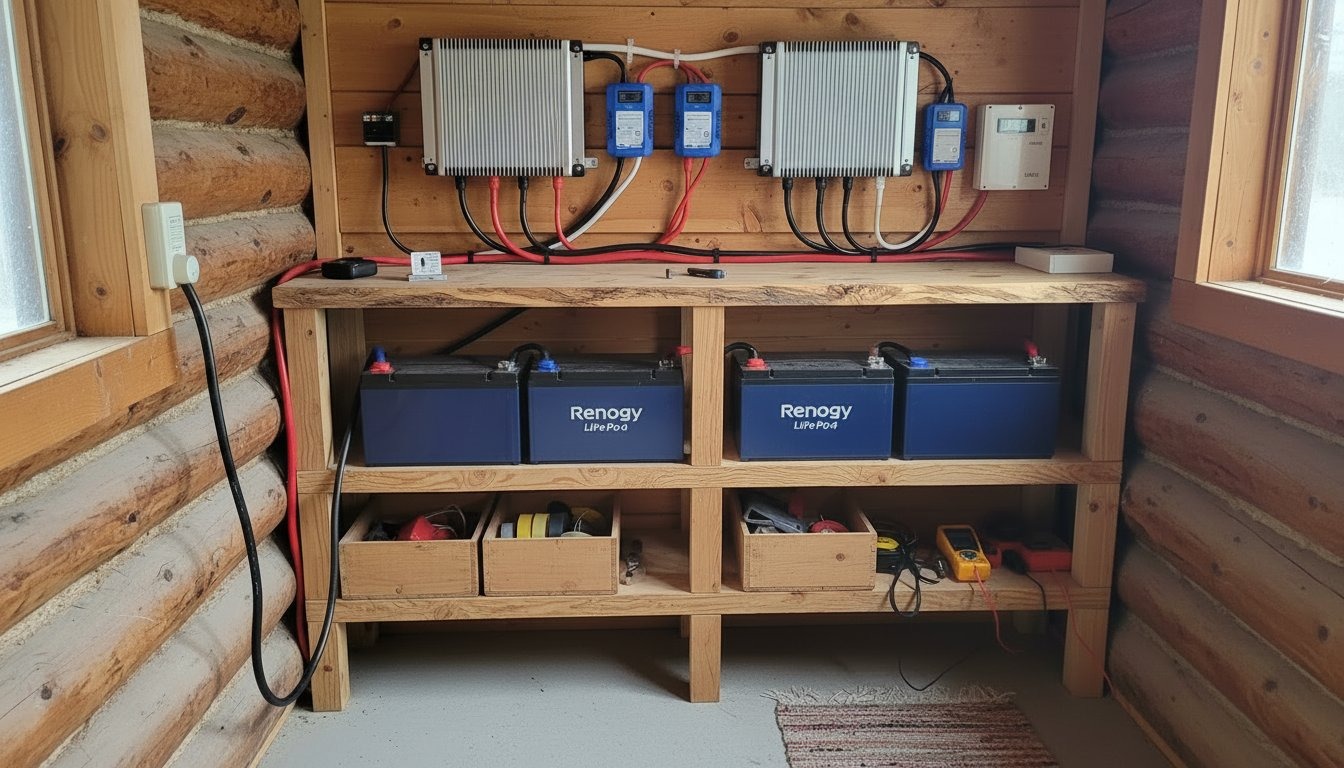
Switching to a LiFePO4 lithium battery bank off-grid changed everything for my cabin setup. A quality 100Ah LiFePO4 cell genuinely delivers 80 to 100% usable capacity. That means a 200Ah bank at 12V gives you a real 1,920 to 2,400Wh to work with. Compare that to an AGM bank where you’re limited to 50% DoD, and you’d need 400Ah of AGM just to match the usable storage of a 200Ah lithium bank – at nearly the same weight and twice the space.
The 12V 100Ah LiFePO4 batteries I’ve tested weigh around 21 to 24 lbs each. Two of them in parallel give you a 200Ah, 2,400Wh bank that fits on a single shelf. My old AGM setup took up an entire utility closet and weighed close to 200 lbs.
The Cold-Weather Problem Nobody Talks About
This is the one that burned me. Standard LiFePO4 cells cannot be charged below 32°F (0°C). They can discharge in the cold – down to about -4°F (-20°C) in select premium-grade cells, though most mid-tier LiFePO4 batteries spec a discharge floor of 14°F (-10°C) – but charging below freezing damages the anode and kills cycle life fast.
For proper sizing methodology, U.S. Department of Energy – Solar Energy and Storage Basics, is a reliable starting point.
In my utility room, which shares an exterior wall and has no dedicated heat source, temps regularly hit the high 20s by February. The first winter I ran lithium, I was unknowingly charging at 28°F on sunny days. By spring, capacity had measurably degraded.
The fix: a self-heating BMS. These boards sense ambient temperature and run a small resistive heater powered by the battery itself before allowing charge current to flow. It draws maybe 10 to 30W to bring cell temp up to a safe range, then opens the charge circuit. I’ve run self-heating banks through two full Oregon winters since then with zero cold-damage degradation.
If your battery space is heated or insulated to stay above 40°F, you can skip the self-heating feature. But if you’re in the PNW and your utility room is against an exterior wall, don’t skip it. LiTime 12V 200Ah LiFePO4 Battery is a 12V 200Ah LiFePO4 bank with a self-heating BMS that I’d recommend for anyone in a similar situation – verified self-heating activation below 32°F and a rated cycle life of 4,000+ cycles.
How to Size a Lithium Battery Bank for Your Off-Grid Cabin
This is the math most people skip, and it’s why they end up under-powered. Here’s the process I use for every cabin setup I help friends configure:
- List every load and its wattage. Fridge (60W avg), LED lighting (30W), laptop (45W), phone charging (20W), well pump (800W surge, 400W run). Add them up.
- Estimate daily watt-hours. Multiply each load’s wattage by hours of daily use. A 60W fridge running 12 hours/day = 720Wh. Add all loads together. My cabin runs about 1,800Wh/day in winter.
- Multiply by your autonomy days. I target 3 days minimum for Oregon winters. 1,800Wh × 3 = 5,400Wh needed.
- Adjust for DoD. LiFePO4 at 80% DoD: divide by 0.80. 5,400 ÷ 0.80 = 6,750Wh nominal capacity needed.
- Convert to Ah at your system voltage. At 48V: 6,750Wh ÷ 48V = approx. 141Ah. Round up to a standard size – a 48V 200Ah bank (9,600Wh nominal) gives solid headroom.
- Account for inverter efficiency. Most quality inverters run 90 to 95% efficient. Factor in a 10% overhead on your total.
- Verify your solar input can refill the bank in 1 to 2 days. A 600W array in Oregon’s November averages maybe 1 to 2 peak sun hours. That’s 600 to 1,200Wh/day input – enough to maintain a small cabin but not recover a deeply discharged 5kWh bank quickly.
For a small cabin running under 1,500Wh/day, a properly sized lithium battery bank covers off-grid cabin needs without overbuilding. For anything with a full-size fridge, electric water heater, or power tools, go 48V and plan for at least 200Ah at that voltage, I’ll cover specific 48V bank recommendations in a dedicated post.
What Specs Actually Matter (And Which Are Marketing Noise)
| Spec | Why It Matters | What to Look For |
|---|---|---|
| Cycle Life | More cycles = longer service life | 3,000+ at 80% DoD minimum; 4,000 to 6,000 is better |
| BMS Continuous Discharge Current | Limits what loads you can run | Match to your inverter’s draw; 100A minimum for cabin use |
| Self-Heating | Critical for cold climates | Required if battery space drops below 32°F |
| Cell Chemistry | LFP vs NMC safety & longevity | LiFePO4 only for stationary off-grid use |
| Expandability / Parallel Support | Future capacity growth | Look for banks rated for 4S or 4P expansion |
| IP Rating | Moisture and dust protection | IP55 minimum for non-climate-controlled spaces |
| Warranty | Manufacturer confidence in cells | 5-year minimum; 10-year preferred |
That table covers what to verify before buying. Here’s what to skip. The specs I ignore: peak discharge current (marketing number, not real-world), “equivalent cycles” claims without DoD specification, and any brand that doesn’t publish a BMS spec sheet.
Renogy 12V 100Ah Pro LiFePO4 Battery fits squarely in the mid tier, self-heating BMS, Bluetooth monitoring, IP67 waterproofing, and a 5,000+ cycle rating. It’s priced toward the top of this range, but the dual protection system and 7-year warranty justify it for a year-round cabin install.
Wiring, BMS, and the Mistakes I Made in Year One
The battery is only part of the equation. The BMS (Battery Management System) is the brain, and a cheap BMS will kill a good battery bank faster than anything else.
Here’s what I got wrong in my first lithium install on the Oregon property:
Mistake 1: Undersized wire. I ran 4 AWG from the battery to my inverter – adequate for a 30A load, but undersized for an 800W inverter pulling 67A at 12V, especially on runs longer than three feet where voltage drop and heat buildup become real concerns. The wire got warm. Warm wire = resistance = lost efficiency and a potential fire hazard. Correct wire for a 12V/1,000W inverter is 2 AWG minimum, and I’d run 1/0 AWG for anything over 1,500W.
Mistake 2: No battery disconnect. When I left the property for two weeks in November, a small parasitic draw (a charge controller with a faulty standby circuit) drained the bank to 0% SoC. LiFePO4 cells that hit 0% don’t always recover cleanly. A simple 200A battery disconnect switch would have prevented this.
Mistake 3: Mixing old and new cells. I tried to add a new 100Ah bank in parallel with a 2-year-old bank. The BMS systems fought each other. Always start with matched cells from the same production batch if you’re building a parallel bank.
A Blue Sea Systems m-Series battery disconnect switch, rated 300A continuous with an IP66 waterproof housing, is exactly what I wish I’d installed from day one. Pair it with any LiFePO4 bank running to an off-grid inverter. Check current price on Amazon.
The National Renewable Energy Laboratory’s off-grid battery research confirms that partial-state-of-charge cycling, the default condition in solar-only systems, is the primary driver of premature capacity loss.
Budget Tiers: What You Get at Each Price Point
Not everyone needs a $2,000 battery bank. Here’s how I break down the 2026 market:
Entry tier ($180 to $320 per 100Ah at 12V): Redodo 12V 100Ah LiFePO4 Battery is the entry tier pick, UL 1973 certified, 4,000+ cycle rating, and a 5-year warranty at a price point well under $250. No self-heating and no Bluetooth, but for a seasonal cabin or a heated utility room, it covers the basics without overpaying. Check current price on Amazon
Mid tier ($450 to $750 per 100Ah at 12V): Better BMS with Bluetooth monitoring, self-heating option, 4,000+ cycle rating, 5-year warranty. This is the sweet spot for a year-round cabin. SOK 12V 200Ah LiFePO4 with Bluetooth BMS and self-heating fits this tier. Check current price on Amazon.
Premium tier ($800+ per 100Ah at 12V, or $700 to $1,100 for 48V 100Ah): Rack-mounted or modular systems with active balancing, CAN bus communication, 10-year warranties, and expandability to 20kWh+. For a full-time off-grid homestead with significant loads, this is where I’d spend the money.
Premium tier systems are typically sold direct from manufacturers like Pylontech, EG4, and Signature Solar rather than through Amazon. If you’re building at this scale, contact them directly for current pricing and configuration support.
Once you’ve bought the right bank, keeping it healthy through a PNW winter comes down to a simple routine.
Maintaining Your Battery Bank Through PNW Winters
After six Oregon winters on various battery chemistries, here’s my maintenance routine for LiFePO4:
- Check state of charge monthly via Bluetooth app or a dedicated battery monitor. A healthy LFP bank should rest at 3.2 to 3.3V per cell (around 50 to 60% SoC) when not in active use.
- Keep terminals clean and tight. Moisture in a PNW utility room corrodes copper terminals fast. I wipe terminals with a dry cloth every 60 days and apply a thin coat of dielectric grease – the kind sold for spark plug boots works fine, and a single tube has lasted me three winters.
- Log your winter solar input. November through February, I track daily input from my charge controller. If I see a week of sub-200Wh days coming, I pre-charge the bank from a generator rather than let it sit below 20% SoC for days on end. My Honda EU2200i burns roughly half a gallon to push 1.5kWh into the bank – not cheap, but cheaper than replacing cells.
- Never store below 20% SoC. If you’re leaving the cabin for more than a week, charge to 50 to 60% and disconnect the loads. LFP cells stored at partial charge age far slower than cells stored fully charged or fully depleted.
- Inspect the BMS heat sink once per year. Dust and spider webs (yes, really – Oregon cabins are full of them) can block airflow and cause the BMS to throttle current.
My Recommendation: Best Lithium Battery Bank for an Off-Grid Cabin
After testing multiple configurations across six winters on my Oregon property, the answer isn’t one specific bank – it’s a spec profile. For a year-round off-grid cabin in a cold, cloudy climate like the PNW, you need: LiFePO4 chemistry, self-heating BMS, 4,000+ cycle rating, 80% usable DoD, and enough capacity for 3 days of autonomy at your average daily load.
A 12V 200Ah self-heating LiFePO4 bank covers most small-to-medium cabins running under 2,000Wh/day. A 48V 100 to 200Ah bank is the right call for anything larger. Budget $700 to $2,000 for a quality unit in 2026, and don’t compromise on the BMS or the cold-weather protection.
For anyone serious about a lithium battery bank off-grid cabin build in the PNW, these are the specs and brands I’d stake my utility room on. Start with Battle Born 12V 100Ah LiFePO4 Battery – run two in parallel for a 200Ah, 2,400Wh bank with a proven 3,000+ cycle rating and one of the strongest warranties in the 12V LiFePO4 market. It’s the configuration I’d buy today if I were starting from scratch. Check current price on Amazon.
Cole Harmon writes about off-grid power, water, and resilience from his property in rural Oregon. Every product mentioned on Grid Down Living has been field-tested in real PNW conditions – not a warehouse, not a press event.