This post contains affiliate links. If you buy through my links I may earn a small commission at no extra cost to you.
The first winter I heated my 400 sq ft Oregon cabin with an undersized stove, I woke up at 3 a.m. to 38°F inside – frost on the inside of the window glass, dog curled into a ball on my feet, fire completely dead. The second winter, after testing three different cast iron units through November ice storms and a January cold snap that dropped us to 14°F at 2,400 feet elevation, I finally got it right.
This guide is what I wish I’d had before spending money on the wrong stove twice.
Quick-Take Summary for Skimmers
If you’re heating a cabin under 600 sq ft in the Pacific Northwest, here’s the short version:
- Size to your space, not your ambition. A stove rated for 1,800 sq ft will roast you out of a 400 sq ft cabin.
- EPA 2020 certification is non-negotiable – Oregon DEQ enforces it, and your off-grid insurance may depend on it.
- Cast iron holds heat longer than steel – critical for overnight warmth without reloading at 2 a.m.
- Burn-time matters more than peak BTU for small off-grid spaces.
- Budget $300-$700 for a quality small-to-mid cast iron unit; budget $1,100-$1,600 for a premium compact model built specifically for tiny spaces.
How to Size a Cast Iron Wood Stove for an Off-Grid Cabin
I oversized my first stove badly. I bought a unit rated for 1,200 sq ft, put it in my 320 sq ft main room, and spent the first month either roasting or letting the fire die down to embers just to stay comfortable. That’s a waste of wood and a creosote nightmare – a smoldering fire is exactly how you build up dangerous deposits in your flue.
The standard rule is 20-25 BTU per sq ft for a well-insulated space. But “well-insulated” doesn’t describe most off-grid cabins in the Pacific Northwest (PNW). My cabin has log walls, single-pane windows on the north face, and a loft that bleeds heat. I use 30-35 BTU per sq ft as my baseline for Oregon mountain conditions.
For a 400 sq ft cabin: 400 x 32 = 12,800 BTU minimum. That sounds low, but remember – a stove rated for 54,000 BTU peak doesn’t run at peak all day. You want a stove whose comfortable, sustained output matches your space. A cast iron unit rated for 900 sq ft genuinely the right size for a 400-500 sq ft well-used cabin in the PNW.
For the math-and-specs side of sizing, the Northwest Energy Efficiency Partnership’s heating load calculator is worth running before you buy – I used it to double-check my 32 BTU-per-square-foot estimate before committing to my current stove, and it confirmed I was in the right range for a 400 sq ft log-wall cabin at 2,400 feet.
Cast Iron Wood Stove vs. Steel: Which Wins for Off-Grid Cabin Heating
Steel stoves heat up faster. Cast iron stoves stay hot longer. For an off-grid cabin where you’re sleeping 10 feet from your stove and can’t afford to reload at midnight every night, that thermal mass difference is real and measurable.
My current stove, a cast iron unit rated at 54,000 BTU for spaces up to 900 sq ft, holds a coal bed for 6-8 hours on a full load of dry Douglas fir. A comparable steel stove I tested the previous winter was down to cold ash in 4 hours on the same load. That two-hour difference matters at 14°F.
Cast iron also handles the expansion and contraction cycles of hard use better over years. Steel stoves can warp at weld seams after repeated high-temperature burns. I’ve seen it on two neighbors’ setups up here on the ridge.
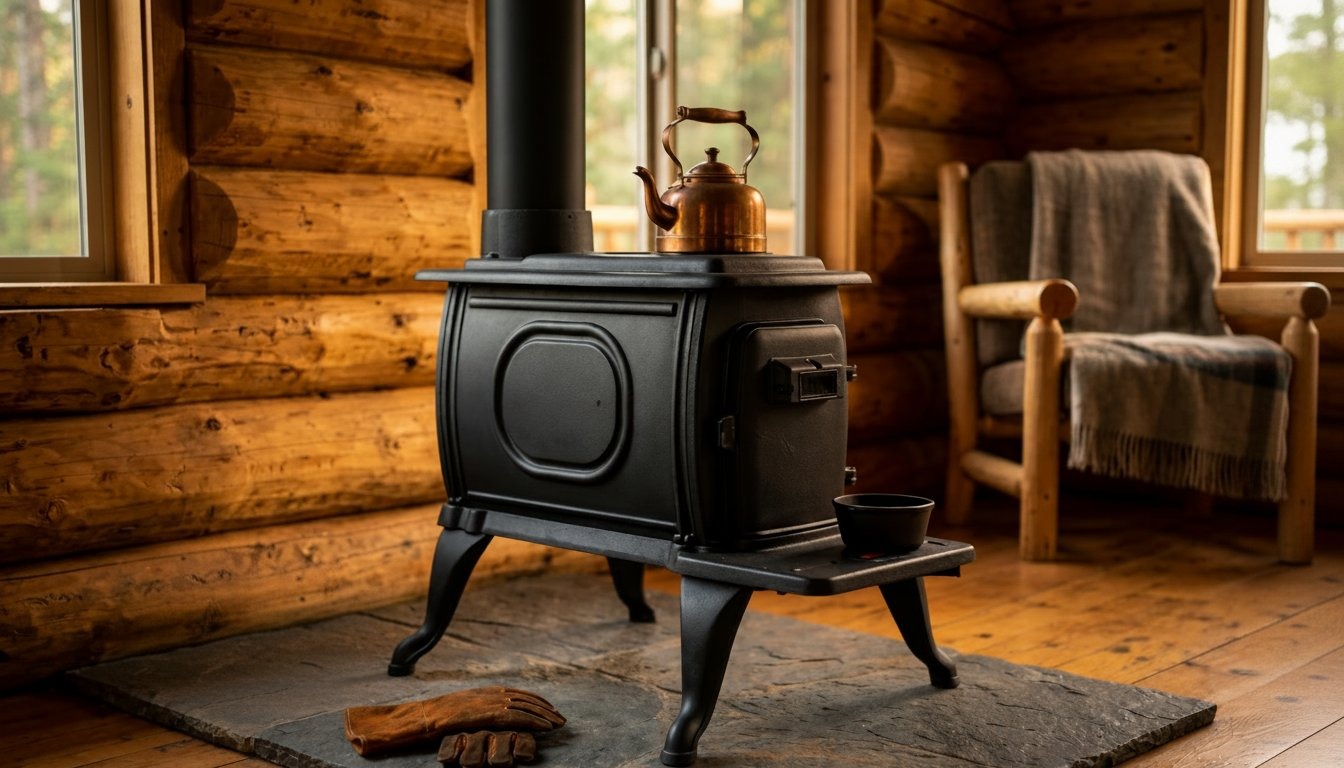
US Stove Company US1269E Cast Iron Wood Stove – For a 400-600 sq ft cabin, look for a cast iron unit with at least 54,000 BTU peak output, a firebox that accepts 17-18 inch logs, and EPA 2020 certification. These run $250-$450 at most retailers.
EPA Certification: Why It’s Not Optional in Oregon (or Most States)
Oregon DEQ adopted the EPA’s 2020 Phase 2 emission standards, which cap particulate matter at 2.0 grams per hour – meaning if you’re building a new off-grid cabin or replacing an existing stove, you cannot legally install a non-certified unit.
Beyond the legal issue, this matters for insurance. When I called my off-grid property insurer to update my policy after installing my current stove, the first question they asked was whether it was EPA certified. An uncertified stove can void your coverage in a fire claim. I’ve talked to two other cabin owners on my road who found this out the hard way.
The good news: most quality cast iron stoves sold today, even budget units in the $300-$500 range, carry EPA 2020 certification. Look for the metal certification label on the back of the unit and verify the model on the EPA’s certified wood heater database before buying.
Comfort Glow Cast Iron Wood Stove – A compact EPA-certified cast iron stove rated for 750-900 sq ft typically weighs 100-150 lbs and requires a 6-inch flue collar. Confirm certification before purchase.
Cast Iron Wood Stove Comparison: Small vs. Mid-Size for Off-Grid Cabins
Here’s how the main size categories stack up for typical off-grid PNW cabin use:
| Category | Small (<30,000 BTU) | Mid-Size (30,000 to 75,000 BTU) | Large (75,000+ BTU) |
|---|---|---|---|
| Best cabin size | Under 250 sq ft | 300 to 600 sq ft | 600+ sq ft |
| Thermal mass | Low, cools in 3 to 4 hrs | Medium, holds 6 to 8 hrs | High, holds 8 to 10 hrs |
| Log length | 12 to 14 inch | 16 to 18 inch | 18 to 22 inch |
| Weight | 75 to 120 lbs | 120 to 200 lbs | 200 to 350 lbs |
| Price range | $200 to $400 | $300 to $700 | $600 to $1,600 |
| PNW overnight verdict | Insufficient for cold snaps | Sweet spot for most cabins | Overkill under 600 sq ft |
For my 400 sq ft Oregon cabin, the mid-size category is the sweet spot. The compact units don’t hold heat long enough through a full PNW winter night, and the large units will cook you out of a small space.
US Stove Company US1269E Cast Iron Wood Stove – A mid-size cast iron stove in the 54,000-75,000 BTU range with a 1.5-2.2 cubic foot firebox and 6-inch flue collar is the most versatile option for cabins in the 400-800 sq ft range.
How to Install a Cast Iron Wood Stove in an Off-Grid Cabin: Step-by-Step
I self-installed my stove and the full chimney run. Oregon requires a permit for wood stove installation – most counties process it in 2-3 weeks and it costs $50-$150. Don’t skip it. Here’s the process I followed:
- Pull your permit first. File with your county building department before touching anything. Most Oregon counties process wood stove permits in 2 to 3 weeks for $50 to $150. Bring your stove’s EPA certification number and a sketch of your flue path.
- Install the hearth pad. The pad must extend at least 18 inches in front of the door and 8 inches on each side. Use a UL-listed stove board rated for wood stove use, minimum 3/8 inch ceramic or equivalent. Pre-cut 36×48 inch pads are the standard fit for most mid-size units.
- Position the stove with correct clearances. Most EPA-certified cast iron stoves require 36 inches from combustibles on the sides and rear with no heat shield, or 12 to 18 inches with an approved shield. Check your specific model’s installation manual, clearances vary.
- Run the flue pipe to the thimble or ceiling support box. Use double-wall insulated pipe (Class A) for any section passing through the wall, ceiling, or attic. Single-wall connector pipe is only for the visible run inside the room, and only up to 10 feet. I used a through-the-attic kit, it’s cleaner than a wall thimble and keeps the chimney warmer (better draft).
- Flash and cap the roof penetration. The roof flashing must be sealed with high-temp silicone rated for the pitch of your roof. The storm collar goes over the flashing. The rain cap screws onto the top of the outermost chimney section. Check for plumb, a crooked chimney drafts poorly.
- Cure the stove before running it hard. First three fires should be small, 90-minute burns with the windows cracked. Cast iron and the paint cure together, skip this and you get permanent smoke smell baked into a cracked finish. After three cure burns, do a full-load test and check every flue joint for smoke leak while the stove is hot.
AllFuel HST 6″ Through-The-Attic Chimney Kit – A complete double-wall chimney pipe kit for a standard 6-inch, single-story installation typically includes 4-6 feet of insulated pipe, a roof flashing, storm collar, and rain cap. Expect to pay $300-$600 for a quality kit.
A non-combustible hearth pad rated for wood stove use should be at least 3/8 inch thick ceramic or equivalent. Pre-cut 36×48 inch pads run $80-$180. Search for UL-listed stove boards in the 36×48 inch size at your local hearth retailer or home improvement store.
Preventing Creosote in a PNW Cabin Wood Stove
Oregon firewood is wet. Even wood I cut and split myself in April is rarely below 20% moisture content by the following November unless I’ve stacked it under cover with good airflow. My moisture meter – the single most useful $20 tool I own – never lies to me I load the stove.
Creosote forms when flue gases cool below 250°F before exiting the chimney. In a PNW winter, that’s easy to do if you’re burning wet wood or running the stove at low smolder to “stretch” your heat. I’ve been there. My first winter I pulled out a chimney brush in March and found a quarter-inch of glazed creosote in the upper flue run. That’s a fire waiting to happen.
My current protocol: burn only wood under 20% moisture content (I target 15-18%), never run the stove at less than 40% of its air capacity for more than 20 minutes, and brush the flue every 60 days during the heating season — October through April up here on the ridge.
That same discipline is what keeps every off-grid system running – I keep a paper log on the cabin wall with dated entries for flue brushings, moisture meter readings, and cord inventory. When I skip the log, I skip the maintenance.
General Tools MMD4E Digital Moisture Meter – A quality firewood moisture meter with dual-pin probes is the most important diagnostic tool for wood stove safety. The General Tools MMD4E reads from 8-30% moisture content, which covers the full range relevant to firewood use. Good units run $20-$45.
Real-World Results: What Three Winters in Rural Oregon Taught Me
Winter 1 (steel stove, wrong size): Woke up cold every night. Burned through 4 cords of wood. Creosote buildup by February. Sold the stove.
Winter 2 (cast iron, mid-size, 54,000 BTU peak, EPA certified): Night temps inside the cabin stayed above 55°F on a full load before bed. Burned 2.8 cords. Flue inspection in March showed light, brushable deposits. This was the stove I should have started with.
Winter 3 (same stove, better wood): I seasoned my Douglas fir for 18 months instead of 8. Average moisture content dropped from 22% to 16%. The stove ran cleaner, the cabin stayed warmer, and I burned 2.3 cords. The stove itself didn’t change – my fuel management did.
The lesson I keep coming back to: the stove is only half the system. Dry wood, correct sizing, and a clean flue are what actually determine whether you stay warm at 2 a.m. in January.
For a cabin in the 400-600 sq ft range, a cast iron unit rated for 900 sq ft with a 54,000 BTU output, EPA 2020 certification, and a firebox accepting 17-18 inch logs is the configuration that’s worked best for me through three Oregon winters.
My Recommendation
After three winters of real-world testing in a 400 sq ft off-grid Oregon cabin, the right cast iron wood stove for most small cabin owners is a mid-size unit in the 54,000-75,000 BTU range, EPA 2020 certified, with a cast iron firebox and at least a 1.5 cubic foot firebox volume. Don’t buy bigger thinking you’ll stay warmer — you’ll burn more wood, build more creosote, and sleep less comfortably. Get the size right first, then focus on your fuel quality and flue maintenance.
The mid-size cast iron configuration described above is the one I’d buy again without hesitation for any cabin under 600 sq ft in the Pacific Northwest. See the US Stove Company US1269E Cast Iron Wood Stove spec comparison above for the full firebox and BTU details.