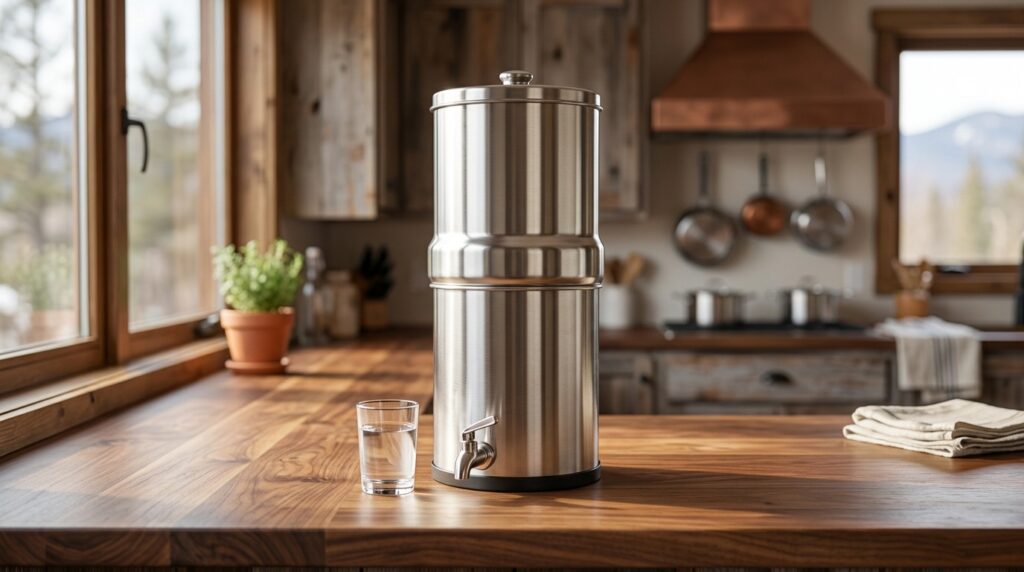
Choosing the right gravity fed water filter for off-grid well water is one of the most important decisions you’ll make for your homestead, and last February, I found out exactly why. That February, during a week of back-to-back atmospheric river storms, our power went out for four days and our pressure tank stopped cycling. No pump, no running water – just a dug well, a hand pump, and whatever was sitting in the upper chamber of the filter on my kitchen counter. That filter kept my family drinking clean water while I troubleshot frozen pipes in 28-degree mud. The filter you choose before that moment matters more than you think.
This post contains affiliate links. If you buy through my links I may earn a small commission at no extra cost to you.
Quick-Take Summary
I ran three gravity-fed systems – the Big Berkey (BK4X2), the Alexapure Pro, and the Aquacera SS-4 with CeraMetix candles – through our rural Oregon property’s dug well for six months. Our water tests at 1.8 ppm iron, 0.4 ppm manganese, and has a pH of 6.3. Here’s the short version:
- Best overall for a family of four: Big Berkey at around $367
- Best budget entry: Alexapure Pro at around $200 to $230
- Best for heavy metals and fluoride: Aquacera with CeraMetix candles, starting around $259
- Biggest mistake I see: buying any gravity filter without pre-filtering sediment first
Why Gravity-Fed Filters Make Sense for Off-Grid Well Water
A gravity-fed filter needs zero electricity, zero water pressure, and zero plumbing. You pour water in the top, gravity pulls it through the filter media, and clean water collects in the lower chamber. For off-grid use – especially in the PNW where grid outages are routine from October through March – that independence is the whole point.
The tradeoff is flow rate. You are not going to run a dishwasher off a gravity filter. But for drinking and cooking water for a family of four, a properly sized system handles the load. I fill ours twice a day during peak summer use and once in winter when we are drinking more hot tea than cold water.
What most buyers miss is that gravity filters are the last line of defense, not the first. If your well water has high sediment or iron, you need a pre-filter stage upstream – even if it’s just a 5-micron sediment sock on your fill bucket – or you will clog your filter elements in weeks instead of months.
What to Look for Before You Buy
Capacity vs. Flow Rate
The Big Berkey holds 2.25 gallons in the lower chamber and filters at up to 3.5 gallons per hour with two Black Berkey elements installed. That sounds reasonably fast, but flow rate drops significantly as the upper chamber empties – gravity pressure decreases as the water level falls. Real-world throughput in my kitchen is closer to 2 to 3 gallons per hour at mid-fill.
The Alexapure Pro also holds 2.25 gallons but uses a single ceramic/carbon hybrid element. Per manufacturer spec sheet, flow rate is slower than the Berkey – noticeably so in cold weather, when our kitchen drops to 48°F overnight and viscosity slows everything down.
Filter Media and Contaminant Coverage
This is where the systems diverge sharply. Black Berkey elements use a proprietary mix of carbon and other media. The Aquacera CeraMetix candles use a diatomaceous earth ceramic outer shell with an activated carbon core and a fluoride-reduction layer. The ceramic shell is scrubable – you can restore flow rate by lightly scrubbing the outside when it loads up with sediment – which matters a lot with iron-heavy water.
Body Material and Build Quality
All three systems I tested use stainless steel bodies. Avoid plastic gravity filters for permanent homestead use. Plastic crazes and micro-cracks over time, especially with repeated temperature swings. Stainless cleans easier and does not leach anything into your water.
Gravity-Fed Water Filter Head-to-Head: Big Berkey vs. Alexapure Pro vs. Aquacera SS-4
| Feature | Big Berkey (BK4X2) | Alexapure Pro | Aquacera SS-4 |
|---|---|---|---|
| Lower chamber capacity | 2.25 gal | 2.25 gal | approx. 2.0 gal |
| Max flow rate (full upper chamber) | 3.5 gal/hr (2 elements) | approx. 1 gal/hr (1 element) | approx. 1 to 2 gal/hr (2 candles) |
| Filter element lifespan | 3,000 gal/element | 5,000 gal total | 650 gal/candle |
| Scrubable ceramic outer shell | No | No | Yes |
| Fluoride reduction (standard config) | No (needs PF-2 add-on) | Yes | Yes (CeraMetix) |
| Current retail price | around $367 | around $200 to $230 | around $259+ |
| Iron performance | Moderate | Moderate | Better (ceramic pre-filters particulate iron) |
| Height | 19.25″ | approx. 21″ | Varies by model |
The Berkey wins on flow rate – nothing else is close when you have two Black Berkey elements running. The Aquacera wins on heavy metal and sediment performance because the scrubable ceramic shell physically captures particulate iron before it ever reaches the carbon core. The Alexapure Pro wins on upfront cost and is a solid starter system if you are on a tighter budget.
Before choosing any filtration system, review EPA’s private well water guidance, especially if your well has never been professionally tested.
Big Berkey BK4X2 Countertop Water Filter System (Big Berkey BK4X2 – check current price and availability)
Alexapure Pro Stainless Steel Water Filtration System (Alexapure Pro – check current price and availability)
Can a Gravity Fed Water Filter Handle High-Iron Well Water?
Our well tests at 1.8 ppm iron – above the EPA secondary standard of 0.3 ppm. I want to be straight with you here because I see a lot of misleading claims online.
Black Berkey elements are rated to reduce ferrous (dissolved) iron, but Berkey’s own documentation does not publish a specific removal percentage for iron at the concentrations found in many rural wells. After 90 days of daily use on our 1.8 ppm well water, the water tasted significantly better – the metallic bite was gone – but I did not have a lab test done at that point. What I did notice: the Black Berkey elements started showing orange staining at the base after about 60 days. That is oxidized iron loading the element.
The workaround that actually helped was adding a 5-micron sediment pre-filter on the fill bucket. I cut a piece of filter sock material and stretched it over the top of the upper chamber. Flow rate through the elements improved and the staining slowed down. It is not a perfect solution, but it extended element life noticeably.
If your iron is above 1 ppm, I strongly recommend pairing any gravity filter with a dedicated iron pre-filter stage, or looking seriously at the Aquacera CeraMetix candles, which handle particulate iron better by design.
Berkey Black Purification Elements Pack of 2 (Replacement Black Berkey Elements – check current price)
How to Set Up a Gravity Water Filter for Off-Grid Well Water
This is the exact process I use at our Oregon property. Takes about 20 minutes the first time.
- Wash both chambers with hot soapy water before first use. Rinse thoroughly. Stainless steel can have a metallic smell from manufacturing.
- Prime your filter elements. For Black Berkey elements, use the included priming button under tap pressure or the Berkey primer bulb if you have no running water. You need to push water through the element from the clean-water side to the raw-water side to saturate the media. Do not skip this – unprimed elements flow at a fraction of rated speed.
- Install elements into the upper chamber and hand-tighten the wing nuts from below. Snug, not gorilla-tight – you can crack the element housing.
- Run two full chambers of water through before drinking. This flushes any carbon fines. The water will look slightly gray on the first pass. Normal.
- Set your system on a stable, elevated surface. I use a 30-inch-tall wooden stand I built from scrap lumber. Height matters – you need clearance below the spigot to fit a full glass or pot.
- Test for leaks at the spigot and element gaskets. Fill the upper chamber and watch for 10 minutes before walking away.
- Establish a fill schedule. For a family of four using filtered water for drinking and cooking only, I fill the upper chamber twice daily – once in the morning and once after dinner. In summer I add a third fill.
Black Berkey Primer for Gravity-Fed Water Filter Systems (Berkey Primer Bulb – useful if you have no running water pressure for priming)
Real-World Performance Through a PNW Winter
The hardest test for any filter system is sustained daily use through a cold, wet Oregon winter. From November through March, I am dealing with water that comes out of the ground at 44°F, a kitchen that drops to the low 50s overnight, and a household that is inside more and drinking more hot beverages.
Cold water is noticeably slower through any gravity filter. The Big Berkey’s flow rate drops – I estimate roughly 30 to 40% slower at 44°F water versus 65°F water, though I did not instrument this formally. The Aquacera ceramic candles showed a similar slowdown but were easier to restore: a quick scrub of the outer ceramic shell with a soft brush brought flow rate back up each time.
The Alexapure Pro had the most noticeable cold-weather slowdown. By January, one fill cycle was taking over two hours – I actually woke up at 5 AM one morning to find less than a quarter-inch of water in the lower chamber, which meant my wife’s morning coffee was delayed while I did an emergency top-up. The lower chamber was sometimes running low by morning.
One thing I was not expecting: condensation. In a cold cabin, the stainless steel lower chamber sweats. I put a folded cloth underneath to protect the wood countertop. Small thing, but worth knowing.
AquaCera CeraMetix 7″ Filter Replacement (Aquacera CeraMetix replacement candles – check current price)
Pre-Filtering for Iron and Sediment: What I Wish I’d Known First
I burned through a set of Black Berkey elements in about eight months on our raw well water before I figured out the pre-filter step. At $60 to $70 per pair for replacement elements, that adds up. Here is the stack I now run:
For baseline water quality standards, the CDC well water safety guidelines, are a useful starting point before sizing any treatment system.
- Stage 1: A 10-inch, 5-micron sediment cartridge filter housing inline before the fill bucket. This catches the bulk of particulate iron and silt.
- Stage 2: The gravity filter (currently the Big Berkey with two Black Berkey elements).
That two-stage approach has extended my Black Berkey element life significantly. I am now past 14 months on the current set with no flow rate degradation. The sediment housing costs about $25 to $40 and replacement 5-micron cartridges run roughly $5 to $8 each. I swap them every 6 to 8 weeks depending on how turbid the water looks after heavy rain.
If your well has significant iron, manganese, or sediment – which describes most dug wells in western Oregon – do not skip this step.
SimPure 10 inch Whole House Water Filter Housing and Sediment Cartridge Kit (10-inch sediment filter housing and cartridge kit – check current price)
Comparing Long-Term Cost Per Gallon
This is the number most buyers ignore at purchase time and regret later.
The Big Berkey’s two Black Berkey elements are rated at 3,000 gallons each – 6,000 gallons total per set.
At a current replacement cost of roughly $130 per pair, that works out to about $0.022 per gallon filtered.
Add the $367 upfront cost amortized over 6,000 gallons and you are at roughly $0.08 per gallon over the life of the first element set.
The Alexapure Pro’s single element is rated at 5,000 gallons. Replacement elements run approximately $45 to $280 each, depending on whether you choose OEM (My Patriot Supply lists genuine filters at approximately $280) or compatible third-party options (available from around $45 on eBay and third-party sellers). That puts long-term cost at about $0.009 to $0.056 per gallon for the element alone – potentially cheaper per gallon than Berkey replacements if you go third-party, but the slower flow rate is a real operational cost in time and inconvenience.
The Aquacera CeraMetix candles are rated at 650 gallons each. Two candles in the SS-4 system = 1,300 gallons before replacement. At roughly $45 to $55 per candle, replacement cost is higher per gallon – but the superior heavy-metal and sediment performance may justify it if your water is particularly challenging.
Alexapure Pro Genuine Replacement Filter (Alexapure Pro replacement filter element – check current price)
My Recommendation
For most off-grid homesteaders with well water, the Big Berkey BK4X2 is the system I keep coming back to. The flow rate advantage is real and matters when you are filling a pasta pot at 6 PM after a long day of outdoor work. The $367 price is not cheap, but the per-gallon cost over time is reasonable, and replacement elements are widely available.
If your well water has high iron or manganese above 1 ppm, pair it with a sediment pre-filter stage and consider upgrading to Aquacera CeraMetix candles in a compatible housing for better particulate metal capture. If you are on a tight budget and can live with slower flow, the Alexapure Pro gets the job done.
Whatever you buy, get it running and dialed in before you need it. The February storm that knocked out our power for four days was not the time to learn how to prime filter elements. Set it up, run it daily, and treat it as your primary drinking water source – not a backup you pull out of a box in an emergency.